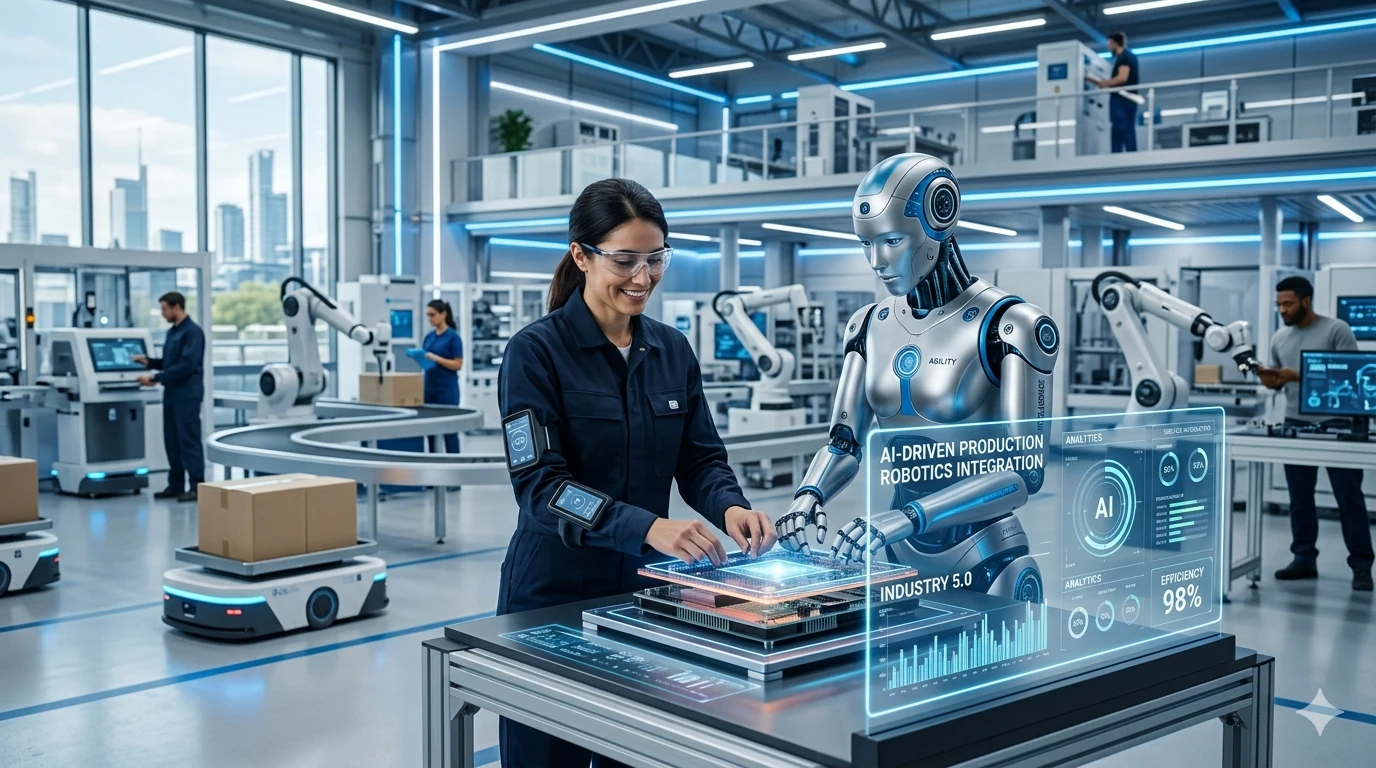
The boundary between the digital and physical worlds is blurring. If the previous decade was defined by the rise of software, the current era is defined by Physical AI—the moment intelligence gains a body. As of 2026, we are no longer just observing a trend; we are witnessing the architecture of a new industrial era.
The Current State: From Automation to Autonomy
In the past, industrial robots were “blind” executors of repetitive code. Today, the integration of Large Language Models (LLMs) and Multimodal AI has transformed these machines into adaptive colleagues.
- Generative Robotics: Thanks to Generative AI, robots can now learn new tasks through simulation (Nvidia’s Isaac Sim) and respond to natural language commands, eliminating the need for complex programming.
- The Rise of Humanoids: 2026 marks the transition from prototypes to series production. With companies like Tesla (Optimus) and BYD deploying thousands of humanoid units, these robots are now performing complex assembly and logistics in environments originally designed for humans.
- Edge Intelligence: Modern robotics has moved processing “to the edge.” This reduces latency, allowing autonomous mobile robots (AMRs) to navigate dynamic warehouse floors with human-like intuition.
Industry 5.0: The Human-Centric Revolution
While Industry 4.0 was about connectivity and “Big Data,” Industry 5.0 focuses on the collaboration between humans and machines. The goal is no longer to replace the worker, but to augment them.
| Feature | Industry 4.0 | Industry 5.0 |
| Focus | Systems & Connectivity | Human-Robot Collaboration |
| Goal | Mass Production & Efficiency | Personalization & Sustainability |
| Tech | IoT & Big Data | Collaborative Robots (Cobots) & AI |
The “skepticism gap” is closing. Manufacturers are increasingly using AI to solve the labor shortage and manage high operational costs (OPEX) through Predictive Maintenance and Software-Defined Operations.
Future Perspectives: 2027-2030 and Beyond
What lies ahead? The roadmap suggests a total transformation of the global economic landscape:
- AGI on the Horizon: By 2027, experts predict significant milestones toward Artificial General Intelligence, where AI can solve complex, cross-domain problems without human intervention.
- The Trillion-Dollar Market: The robotics sector is expected to explode, with some estimates valuing the humanoid and service robot market at over $200 billion by 2035.
- Sustainability as a Driver: AI will be the primary tool for achieving “Net Zero” in manufacturing, optimizing energy consumption in real-time and enabling the use of recycled materials through hyper-precise sorting.
The Labor Paradox: Reskilling for the Intelligence Age
The most common question remains: Will robots take our jobs? The reality in 2026 is a “Job Shift” rather than “Job Loss.” While 65% of repetitive retail and manual tasks are prone to automation, the demand for AI Orchestrators, Robot Maintenance Specialists, and Ethical Governance Officers is skyrocketing.
“The challenge is not building the intelligence, but building the control and the human-centric frameworks to guide it.”
Real-World Applications: Leading the Change
To understand the practical impact of this shift, we only need to look at how industry leaders are actively deploying these technologies today:
- BMW and Figure AI: At BMW’s Spartanburg manufacturing plant, general-purpose humanoid robots are being integrated to automate difficult, unsafe, or highly tedious tasks. This partnership proves that human-robot co-working is no longer science fiction, but a present-day reality on the factory floor.
- Amazon’s Collaborative Logistics: With the deployment of systems like ‘Sequoia’ and Agility Robotics’ bipedal robot ‘Digit’, Amazon has transformed inventory management. Digit handles the repetitive heavy lifting of tote recycling, allowing human employees to focus on more complex, value-added tasks within order fulfillment.
- Siemens and the Industrial Metaverse: Siemens is using AI-driven “digital twins” to simulate and optimize entire production lines virtually before a single physical machine is turned on. This predictive approach drastically reduces material waste, energy consumption, and operational downtime.
Conclusion
We are fully immersed in the Intelligence Age. The transition from digital chatbots to autonomous physical agents is the defining hallmark of this decade. However, the true differentiator in this new industrial revolution is not the technology itself, but our response to it.
Resisting this technological tide is a losing strategy. For both businesses and individual workers, the ultimate currency is now adaptability. We must be willing to challenge our own assumptions, unlearn outdated habits, and actively learn new ways of working alongside our robotic counterparts. By embracing this change rather than fearing obsolescence, we can step into a future where AI and robotics act not as replacements, but as powerful catalysts for human potential and unprecedented innovation.